If you’re trying to replace a damaged rim or upgrade without guessing, knowing your OEM wheel size is the most important first step. The good news? You can find your exact factory rim size in less than three minutes, using information already on your car.
Let’s break it down clearly so you know exactly what to look for.
Where to Find Your Wheel Size (4 Proven Methods)
Most OEM wheel sizes can be identified in under two minutes once you know where to look. Here are the four most reliable sources used by technicians and dealerships:
1. Tire Sidewall (The Fast Visual Method)
Look for a number like “P235/60R18” printed on the tire. The final number (18) is your wheel diameter in inches.
Warning
Tire size does not show you the wheel width, just its diameter.
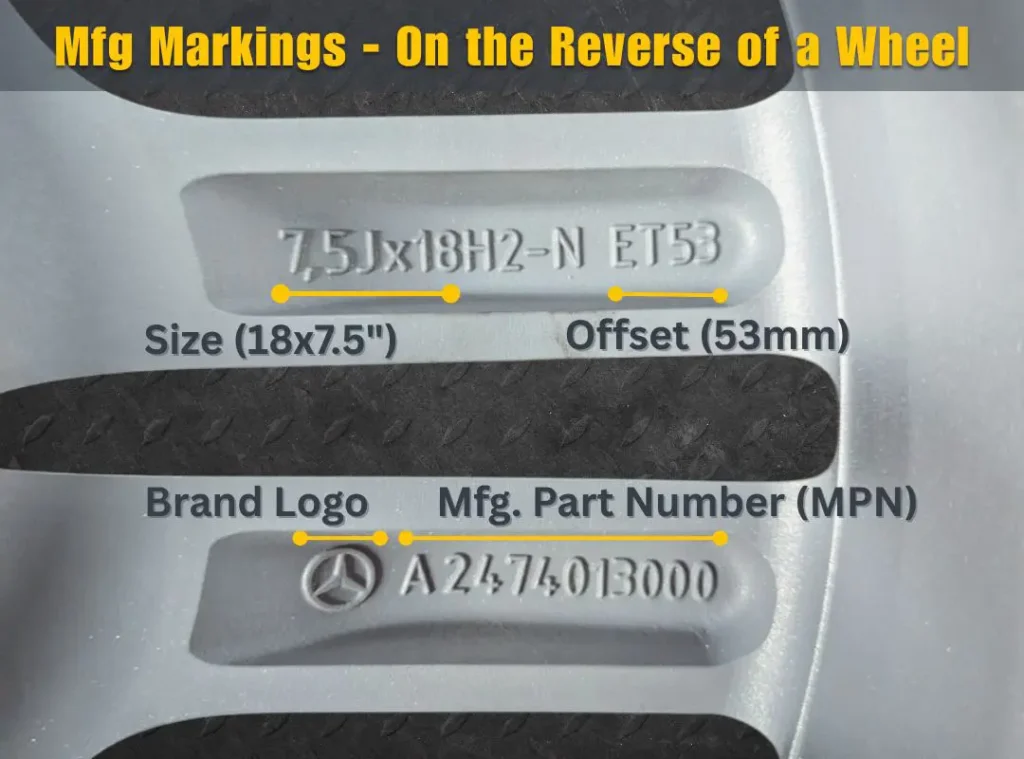
2. Backside of the Wheel (Stamped OEM Markings)
Remove the wheel or look through the spokes using a flashlight.
You’ll find cast or stamped numbers such as:
- 18×7.5J → diameter × width
- ET45 → offset
- 5×114.3 → bolt pattern
- 64.1 → center bore
These markings are the most accurate source for all OEM sizing.
3. Driver Door Jamb Sticker
Open your driver’s door and check the pressure label.
Some vehicles list the factory wheel size for front and rear axles.
Example:
“18×7.5J” or “17” will appear next to recommended tire sizes.
4. Manufacturer or OEM Fitment Databases
Dealerships and certified wheel suppliers keep exact OEM fitment specs for every trim and year.
You can check them using:
- Your VIN
- Your year, make, model, and trim
Important
This is the method WheelSmart Rims uses to guarantee proper fitment.
What Is My Wheel Size and Why Does It Matter?
Your OEM wheel size determines:
Get it wrong, and you risk rubbing, vibration, TPMS issues, or wheels that simply don’t fit your vehicle.
Get it right, and you’ll restore your vehicle’s original ride quality — exactly how the manufacturer engineered it.
The 3 Fastest Ways to Find Your OEM Wheel Size
These three methods cover 99% of vehicles.
1. Check the Tire Sidewall (Fastest Method)

Look at the numbers written on your tire.
Example: P235/60R18
The last number — 18 — tells you your wheel diameter in inches.
- 18 = 18-inch OEM wheel
- 17 = 17-inch OEM wheel
- 19 = 19-inch OEM wheel
This is the quick way, but keep in mind:
👉 If your car has aftermarket wheels on it, your tire may not show the factory size.
2. Look at the Back of the Wheel (Most Accurate)
You’ll find numbers like:
- 17×7.5J → diameter × width
- ET47 or +47 → offset
- 7.5Jx17H2
- 5×112 → bolt pattern (sometimes printed, sometimes not)
These numbers are usually on:
- The inner barrel
- Behind the spokes
- Near the mounting pad
Take a photo with your phone — it’s much easier than reading them upside down
Use Your Vehicle’s Manual or Driver’s Door Sticker

On your driver-side door jamb, look for the Tire and Loading Information label.
It usually lists:
- OEM tire size
- Load rating
- Recommended pressure
While some stickers don’t list wheel width, it confirms the factory wheel diameter.
These auto date labels are regulated by the National Highway Traffic Safety Administration (NHTSA)
OEM Wheel Size Terms You Need to Understand
Diameter
The size of the wheel from bead to bead.
Common OEM sizes:
16″, 17″, 18″, 19″, 20″, 22″.
Width
Measured from inside bead to inside bead.
Examples: 7.0″, 7.5″, 8.0″, 9.0″, 10.0″.
Offset
How far the wheel sits from the hub mounting surface.
Marked as ET45, +45, 0, –12, etc.
Bolt Pattern
The number of lug holes × distance between them.
Examples:
4×100
5×114.3
5×112
6×139.7
How far the wheel sits from the hub mounting surface.
Marked as ET45, +45, 0, –12, etc.
Center Bore
Hole in the middle of the wheel where it centers on the hub.
Important for vibration and proper fitment.
Common Wheel Markings Explained (OEM Cheat Sheet)
Here’s what you’ll typically see on the back of an OEM wheel — and what each marking actually means:
Marking Example | Meaning | Description |
|---|---|---|
18×7.5J | Wheel Size | Diameter × width |
ET45 | Offset | How far the wheel sits inward/outward |
5×114.3 | Bolt Pattern | Number of lugs & distance between them |
CB 64.1 | Center Bore | Fits the vehicle’s hub for a vibration-free ride |
7J | Flange/J-Lip Code | Type of wheel lip design (standard J) |
Made in Japan/Mexico/etc. | Production Origin | OEM factories or suppliers |
How to Measure Wheel Size Yourself (If Markings Are Missing)
Sometimes corrosion or refinishing removes OEM markings. In that case, you can still determine the wheel size manually:
A) Diameter
Measure across the wheel from bead seat to bead seat — not the outer rim.
A tape measure works fine.
B) Width
Measure between the inner and outer bead seats.
This will usually be 0.5–1.0″ less than the overall outer width.
C) Lug Spacing (Bolt Pattern)
- For 5-lug wheels: measure from the center of one lug to the far edge of the opposite lug.
- Convert to standard (e.g., 114.3 mm).
D) Offset (Approximate Method)
Measure:
- The backspacing (mounting pad → inner wheel lip)
- Overall wheel width
Offset formula:
(Backspacing – (Overall Width / 2)) × 25.4 = Offset (mm)
It won’t be perfect, but it gets you within a few millimeters.
How to Know if You Have OEM Wheels or Replacements
Quick check:
| Feature | OEM Wheels | Replica / Aftermarket |
|---|---|---|
| Part number | Always present | May vary or be generic |
| Manufacturer logo | Usually stamped or cast | Not always present |
| Weight | Typically lighter | Replicas can be heavier |
| Backside markings | Very standardized | Can vary by brand |
Should You Replace or Repair a Damaged OEM Wheel?
If your wheel has:
- A crack
- Severe bends
- Metal fatigue
- Missing chunks
- Leaking air
Repair shops may offer welding, but OEM safety standards say many cracked wheels should be replaced, not repaired.
For safety and structural integrity, a factory OEM or certified replacement wheel is the best option.
Common Mistakes When Identifying Wheel Size
Avoid these frequent errors that lead to ordering the wrong wheel:
- Using tire width as wheel width.
Tire width (e.g., 235mm) is completely unrelated to rim width. - Assuming all trims use the same wheel size.
EX: a Honda Accord LX and Sport use different OEM wheels. - Confusing offset with bolt pattern.
ET45 has nothing to do with 5×114.3. - Not checking center bore compatibility.
Even if the lug pattern matches, a center bore mismatch causes vibration. - Mixing metric and imperial measurements.
Bolt patterns always use millimeters — wheel width always uses inches.
Find Your Exact OEM Wheel Size by Vehicle
If you want your wheel replaced with the exact factory specifications, select your vehicle below:
Ready to Replace Your Wheel? We Guarantee the Right Fit.
At WheelSmart Rims:
Need an exact OEM replacement for your vehicle?
WheelSmart Rims stocks factory OEM wheels, reconditioned OEM rims, and certified replicas, all guaranteed to fit your year, make, and model.
Frequently Asked Questions
Where is my wheel size located?
You can find it on the backside of the wheel (stamped), the tire sidewall (diameter only), or the driver door jamb label. The stamped wheel numbers are the most accurate.
Can I switch from 17-inch wheels to 18-inch wheels?
Yes, as long as the offset, bolt pattern, width range, and overall diameter remain within safe limits. Many vehicles support multiple OEM sizes.
What happens if I use the wrong offset?
Incorrect offset can cause rubbing, poor steering feel, bearing stress, or wheels sticking out past the fenders. Stick within ±5–10 mm of OEM when possible.
Is OEM wheel size the same as tire size?
No. Tire size only gives wheel diameter, not width, offset, bolt pattern, or center bore. Use the stamped wheel markings for complete specifications.
Do different trims of the same car use different OEM wheels?
Yes. Sport, Touring, Limited, or Performance trims often use wider wheels, different offsets, or larger diameters than base models — always verify by year + trim.
Where exactly is the wheel size stamped on my rim?
On alloy wheels, check the backside of the wheel between the spokes. On steel wheels, look at the front side or face. The numbers appear as something like 16×7, 17×7½, or backwards as 7.5×17.
On the back of the rim, you may also find:
– OEM part number
– Country of origin
– Manufacturer stamp
– Date code
Want to know more?
Here are some Related Guides: